Introduction
Artificial Intelligence is rapidly changing how businesses interact with customers, manage operations, and automate daily tasks.
As AI becomes more popular, two terms are being used more frequently:
- AI Chatbots
- AI Agents
Many businesses assume these are the same thing.
At first glance, they may appear similar because both can communicate with users and provide automated responses. However, once you look deeper, the difference becomes much more significant.
This misunderstanding creates confusion for many businesses trying to adopt AI solutions.
Some companies invest in basic chatbot systems expecting advanced automation. Others hear the term “AI Agent” and assume it is simply another name for a chatbot.
But in reality, these systems are built for very different purposes.
Understanding this difference is important because choosing the wrong solution can limit your business operations and reduce the effectiveness of your automation strategy.
The truth is simple:
“A chatbot mainly communicates.
An AI agent can communicate, think, decide, and perform actions.
That difference changes everything.
What Is an AI Chatbot?
An AI chatbot is a system designed mainly to interact with users through conversation.
Its primary purpose is communication.
A chatbot receives questions or messages from users and responds based on predefined rules, trained responses, or AI-generated answers.
Most businesses are already familiar with chatbots because they are commonly used on:
- Websites
- Facebook Messenger
- Customer support systems
For example, a chatbot may answer questions such as:
- “What are your business hours?”
- “Where are you located?”
- “How can I contact support?”
In many cases, chatbots are used to reduce the workload of customer support teams by handling repetitive inquiries automatically.
This makes them useful for businesses that receive a large number of common questions every day.
How Traditional Chatbots Work
Traditional chatbots are usually built around predefined flows or response structures.
This means they operate within a limited set of instructions.
For example:
If a customer asks:
““Do you offer delivery?”
The chatbot may provide a prepared response explaining delivery options.
However, if the customer asks something unexpected or more complex, the chatbot may struggle to understand the request properly.
This is because many chatbots are designed mainly for conversation — not deeper reasoning or decision-making.
They are reactive systems.
They wait for input and provide responses based on what they were programmed or trained to do.
The Main Purpose of a Chatbot
The core goal of a chatbot is to improve communication efficiency.
It helps businesses:
- Respond faster
- Reduce repetitive support work
- Provide instant answers
- Improve accessibility
Chatbots are especially useful for handling:
- Frequently asked questions
- Basic customer support
- Simple inquiry management
For many businesses, this alone can already improve customer experience significantly.
What Is an AI Agent?
An AI agent goes much further than a chatbot.
Instead of only responding to messages, an AI agent is designed to understand goals, make decisions, and perform actions automatically.
This means an AI agent is not limited to simple conversations.
It can:
- Analyze situations
- Access tools or systems
- Execute tasks
- Manage workflows
- Make logical decisions based on context
This makes AI agents much more dynamic and capable compared to traditional chatbot systems.
The Simplest Way to Understand the Difference
The easiest way to understand this is:
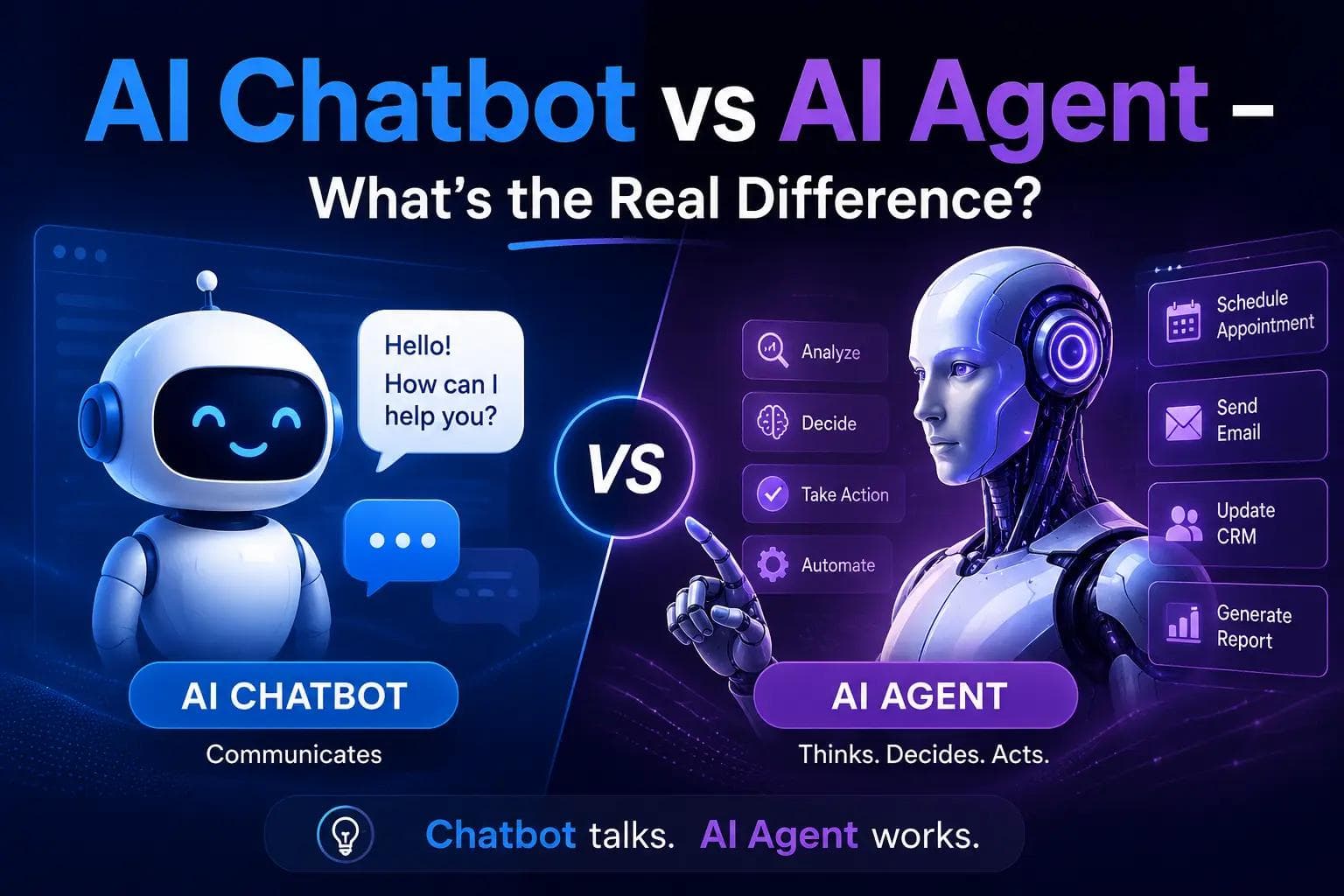
“A chatbot talks.
An AI agent works.
A chatbot mainly focuses on communication.
An AI agent focuses on achieving tasks and objectives.
For example:
A chatbot may answer:
““Your appointment is tomorrow at 3 PM.”
An AI agent may:
- Schedule the appointment
- Send reminders
- Update the calendar
- Notify the team
- Handle rescheduling automatically
This is a completely different level of functionality.
AI Agents Can Take Actions, Not Just Respond
One of the biggest differences between AI chatbots and AI agents is the ability to take actions.
A chatbot may provide information.
But an AI agent can interact with systems and perform operations.
For example, an AI agent may:
- Book appointments
- Generate reports
- Follow up with leads
- Send emails automatically
- Manage workflows
- Retrieve information from databases
- Update CRM systems
This transforms AI from a communication tool into a business operation tool.
Why AI Agents Are Becoming More Important
Businesses today are dealing with increasing workloads and growing customer expectations.
Customers expect:
- Faster responses
- Better service
- Instant communication
At the same time, businesses want to:
- Reduce repetitive work
- Improve efficiency
- Save time
Traditional chatbots help solve communication problems.
But AI agents go further by helping businesses automate actual processes.
This is why AI agents are becoming one of the most important developments in modern business automation.
Real Business Example (Simple Comparison)
Let’s imagine a customer visits an online store.
What a Chatbot Might Do:
- Answer product questions
- Explain delivery information
- Share pricing details
What an AI Agent Might Do:
- Recommend products
- Check inventory
- Process the order
- Send confirmation emails
- Handle follow-up communication
- Track delivery updates
The chatbot supports communication.
The AI agent supports operations.
Do AI Agents Replace Chatbots?
Not necessarily.
In many cases, AI agents and chatbots work together.
A chatbot can act as the communication interface, while the AI agent handles the actual logic and actions behind the scenes.
This creates a much more powerful and intelligent system.
For example:
The user may feel like they are chatting with a normal assistant, but behind the conversation, the AI agent may be:
- Accessing databases
- Scheduling tasks
- Triggering workflows
- Making decisions
This combination creates smoother and more useful user experiences.
Why Many Businesses Still Use Basic Chatbots
AI agents are powerful, but many businesses still start with chatbots because they are simpler and easier to implement.
For businesses with basic customer support needs, a chatbot may already provide enough value.
Examples include:
- Answering FAQs
- Collecting contact information
- Basic inquiry handling
However, as businesses grow and require more automation, limitations begin to appear.
This is where AI agents become more valuable.
When Businesses Should Consider AI Agents
AI agents become useful when businesses need more than simple conversations.
This includes situations where businesses want to:
- Automate repetitive tasks
- Handle workflows automatically
- Improve operational efficiency
- Reduce manual workload
- Connect multiple systems together
AI agents are especially valuable for businesses dealing with:
- High customer interaction
- Appointment systems
- Sales processes
- Lead management
- Workflow automation
Common Misunderstanding About AI Agents
One major misconception is that AI agents are magical systems that can replace entire teams instantly.
This is not true.
AI agents are tools designed to assist and improve business operations.
They still require:
- Proper planning
- Good workflows
- Clear business goals
The best results happen when AI systems are designed around real business problems instead of unrealistic expectations.
The Future of AI Agents and Business Automation
AI technology is evolving rapidly.
Over the next few years, businesses will increasingly move from basic chatbots toward more intelligent AI agent systems.
This shift will happen because businesses want more than automated replies.
They want systems that can:
- Work independently
- Manage processes
- Improve efficiency
- Support business growth
AI agents represent the next stage of business automation.
Businesses that start understanding and exploring these systems early will have a major advantage in the future.
Final Thoughts
AI chatbots and AI agents may sound similar, but they serve very different purposes.
Chatbots mainly focus on communication and answering questions.
AI agents go further by understanding tasks, making decisions, and performing actions automatically.
For businesses, this difference is extremely important.
Choosing the right solution depends on:
- Your business goals
- Your workflow complexity
- Your automation needs
As AI technology continues to grow, understanding these systems early will help businesses adapt more effectively and stay competitive in the digital world.
📞 Need Help?

If you are exploring AI automation or want to build AI-powered solutions for your business, Codilent IT Solutions can help you design and implement systems tailored to your business needs.
We help businesses with:
- AI chatbot development
- AI agent solutions
- Business automation systems
- AI-powered customer support
Contact us today for a FREE consultation and discover how AI solutions can support your business growth.
Have an idea worth building?
Let’s turn your next digital product idea into a meaningful, high-performing experience.